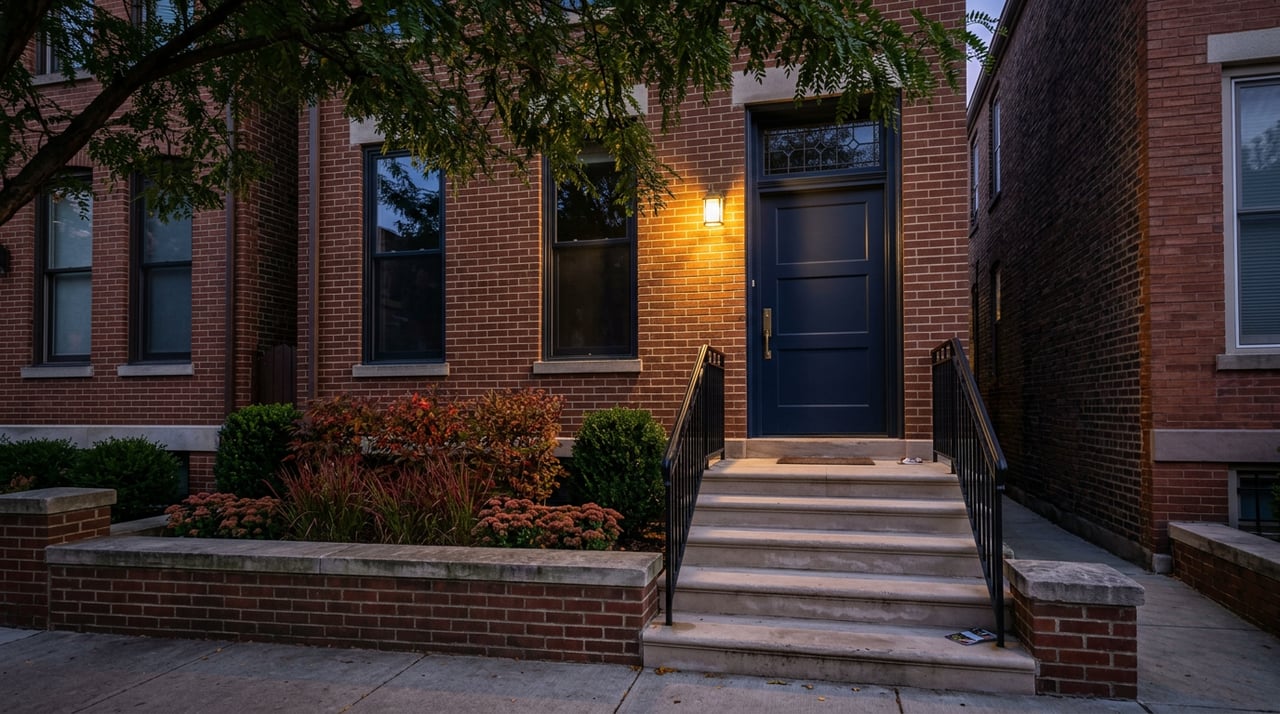
Now In Real Estate
Old Town's Newest Tradition Is Just Its Oldest Story, Finally Getting Told
September 10, 2026
Now In Real Estate
September 10, 2026
Walk past House of Glunz at 1206 North Wells some weekday morning this month and you'll see crews stringing lights and setting up barricades along the block. Ask what's going up and you'll hear that Old Town Oktoberfest returns September 18 through 20, its second year running on the same stretch of Wells Street that hosted the festival's debut last September, not far from Cobbler Square Lofts, the converted Dr. Scholl's factory building that anchors the block. The wine shop behind those workers has been on that corner since 1888.
That gap, a festival barely a year old sharing a block with a business pushing 140, is the whole story of Wells Street right now. Old Town didn't import Oktoberfest from somewhere else. It waited a long time to throw a party its own history had already written the invitation for.
Old Town Oktoberfest debuted quietly in September 2025, staged by the Old Town Merchants & Residents Association on Wells Street. It comes back for its second run this September 18 through 20 with a fuller calendar than year one: bratwurst and pretzels, German-inspired bands, a big screen for football, and the Masskrugstemmen stein-holding contest that already became the event's signature moment. New this year is a dog parade, the First Annual Dog Parade at Old Town Oktoberfest, with categories only a neighborhood this specific would bother naming: Wee Wieners for anything under 30 pounds, Pretzel Pups from 31 to 70, and Big Bratwursts for anything larger, with check-in at a stage on Schiller and Wells.
A festival that adds its own dog parade in year two isn't scrambling to fill a program. It's an organization confident enough in what it built the first time to keep layering on top of it.
Old Town was Chicago's first German neighborhood, and Wells Street still carries the receipts. House of Glunz, founded in 1888 by an immigrant from Westphalia, is the oldest family-owned wine shop in the country and it never left its original corner. A few blocks over on Sedgwick, Oscar and Gottfried Mayer opened the small butcher and sausage shop in 1883 that eventually became the company whose hot dogs are now sold nationwide. Neither business needed a festival to prove the neighborhood's German roots. They've been standing evidence of it for well over a century.
That's why Oktoberfest reads differently here than the same event would in a neighborhood without that backstory. A pop-up beer garden with no connection to the block would be a rented atmosphere. Here, the festival is closer to a neighborhood association finally scheduling the party its oldest storefronts had already been throwing quietly, one wine bottle and one sausage link at a time, since before the street had streetlights.
The evidence that Old Town is still being written, not just preserved, shows up somewhere else on the same street: FARE, the fast-casual bowl and coffee concept that started as a single counter inside a downtown food hall, opened its Old Town storefront this year at 868 North Wells. The address puts it near Layla & Ringo's Cafe, DJ's Great Room, and Petite Edith, tucked into the ground floor of a new apartment building.
That location matters more than the menu. FARE built its business on quick breakfasts and midday bowls, the kind of traffic that depends on people already living or working within a few blocks, not visitors passing through for dinner and a Second City show. A concept built around grab-and-go coffee doesn't bet on a corridor unless the daytime foot traffic already supports it. Wells Street has spent years being described, accurately, as a nightlife strip. A bowl-and-coffee counter opening at the base of new apartments is a quieter kind of proof that the block's daytime population is growing too, not just its bar crowd.
For every new arrival, the fixtures that make Wells Street recognizable haven't budged. Twin Anchors, on Sedgwick since 1954, is still the rib joint where Frank Sinatra used to eat when he was in town, and the dark wood and jukebox haven't changed much since. The Old Town Ale House, open since 1958 a few blocks north, is still cash only, still covered in the owner's own paintings of neighborhood characters and passing celebrities, still the kind of bar where regulars have held the same stool for decades. The Second City still runs a live show every night of the week on the same stage that launched Bill Murray, Tina Fey, and Chris Farley, among a list long enough that most Chicagoans stop reading it halfway through.
These places aren't nostalgia acts competing with the new openings. They're the reason the new openings choose this block in the first place. A festival organizer picking a street for a German heritage event, or a fast-casual chain scouting its next storefront, both benefit from a corridor that already has an identity strong enough to draw people who weren't planning to eat there.
Oktoberfest isn't the first time the Old Town Merchants & Residents Association has closed this stretch of Wells Street and watched people show up. The Wells Street Art Festival, held every year on the second full weekend of June, draws more than 50,000 visitors and over 130 artists to the same corridor, from North Avenue down to Division Street. That event has run long enough to become a fixture of the neighborhood's summer, not an experiment.
Oktoberfest borrows that exact structure: same organizing group, same general blocks, same idea that closing a street to cars and filling it with food, music, and something to look at works here in a way it might not work somewhere without Old Town's built-in walkability and density of restaurants and bars. The festival is new. The formula it's running is not. That's a meaningful difference for anyone trying to guess whether Oktoberfest sticks around for a tenth year or fades after its third. A neighborhood that already fills its streets once a summer for an art fair isn't taking much of a risk by doing it again in September for bratwurst.
A few things worth knowing before the festival tents go up:
What's actually happening on Wells Street this fall isn't a story about a new festival or a new coffee counter arriving in a neighborhood that stayed the same underneath them. It's a story about a block that keeps finding new ways to say something true about itself that it hadn't gotten around to saying out loud yet. The wine shop from 1888 didn't need Oktoberfest to prove Old Town's German history. The rib joint from 1954 didn't need a new apartment building to prove the street could support foot traffic. But put them all next to each other in the same two-week stretch of September, and the picture that emerges is a neighborhood confident enough in what it already is to keep adding to it rather than replacing any of it.
That's the version of Old Town worth knowing if you already live here: not a neighborhood being discovered, but one still writing its own footnotes.
If you're thinking about what a home on a block like this is actually worth, or how a street with this kind of layered history gets priced and shown, Diana Marcus and the Marcus Pesche Residential team know the North Shore and these Chicago corridors well enough to walk you through it. Reach out when you're ready to talk.
September 10, 2026
September 3, 2026
August 27, 2026
August 20, 2026
August 13, 2026
August 6, 2026
August 6, 2026
July 23, 2026
July 16, 2026
We combine luxury marketing with hands-on service. Our clients benefit from proactive communication and refined strategy. Let’s elevate your real estate experience.

Marcus Pesche Residential
1741 2nd St Highland Park, IL 60035